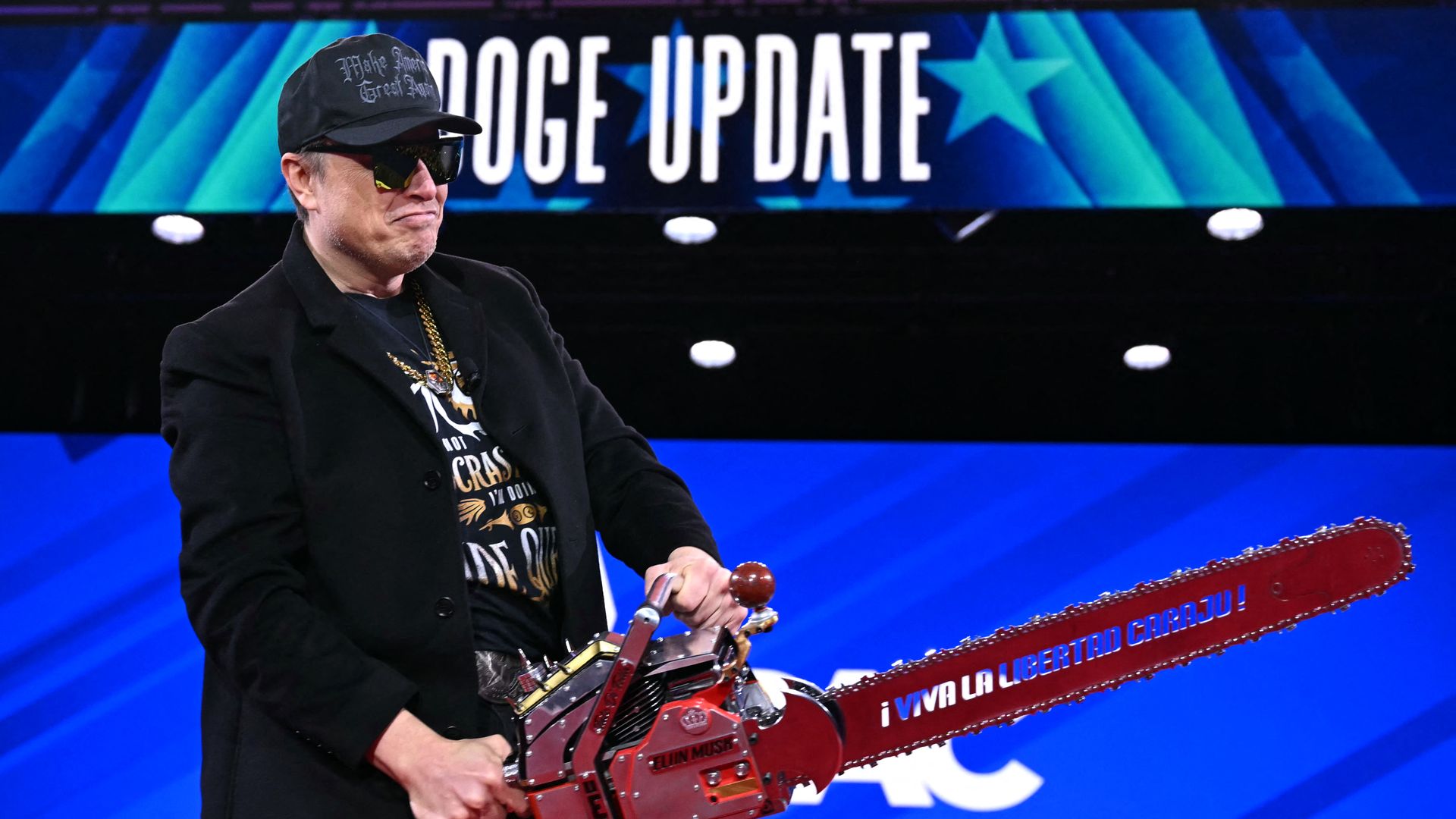
As economic uncertainty roils the markets, funders who are being asked to help nonprofits weather the administration’s draconian cuts are watching the value of their portfolios fluctuate thanks to the policies of the same president whose underlings are wielding the figurative (and literal) chainsaw.
The irony would be almost comical were it not for the stark fact that countless lives hang in the balance.
Anxiety is especially acute for development officers at elite universities. On March 7, the Trump administration announced the cancellation of $400 million in federal grants and contracts to Columbia University “due to the school’s continued inaction in the face of persistent harassment of Jewish students,” according to a Department of Health and Human Services press release. “These cancellations represent the first round of action and additional cancellations are expected to follow.”
Three days later, the U.S. Department of Education’s Office for Civil Rights sent letters to 60 universities warning them of “potential enforcement actions if they do not fulfill their obligations under Title VI of the Civil Rights Act to protect Jewish students on campus, including uninterrupted access to campus facilities and educational opportunities.” On March 13, the Trump administration dictated a set of extensive demands to Columbia that it says the university would need to meet to see funding restored.
If the Columbia announcement is a harbinger of things to come, officials at universities that are under investigation by the administration will need to brace for significant funding cuts. Some schools aren’t waiting for the other shoe to drop — on March 10, for example, Harvard announced a hiring freeze, citing “substantial financial uncertainties driven by rapidly shifting federal policies.”
On the surface, Columbia’s loss of federal funding would seem to raise the familiar university development office hope that philanthropy — or in this case, affluent alumni donors — will step in to fill holes in the university’s budget. And while this thinking applies to the broader higher education field, the Columbia episode is unique in that some of the same billionaire alumni to whom development officers would normally turn pledged to withhold donations after the October 7, 2023, attack, citing concerns similar to those articulated by the DHHS.
These donors are now faced with a crucial decision. Will they conclude that their boycott served its purpose and pull out their checkbooks before the damage becomes irreparable? Or will they stand pat, even if it means, as is expected at Columbia, officials will be forced to cancel research projects and terminate employees?
Revisiting the post-October 7, 2023 alumni donor boycott
In the wake of Hamas’ October 7, 2023, attack on Israel that killed some 1,200 people, several billionaire alumni pledged to withhold funding to their alma maters, citing officials’ failure to forcefully condemn the attack, punish antisemitic protestors and protect Jewish students from harassment.
After the attack, Columbia alumnus and hedge fund billionaire Leon Cooperman said he would suspend his giving, although the following April he revised that and told CNBC he would continue donating to the business school “when they solicit” him. That same month, New England Patriots owner Robert Kraft issued a statement through his Foundation to Combat Antisemitism, stating, “I am no longer confident that Columbia can protect its students and staff and I am not comfortable supporting the university until corrective action is taken.”
In October 2024, the Columbia Spectator reported that “as the university grapples with a donor crisis — born out of concerns regarding campus protests,” its 12th annual Giving Day raised $21 million — a 28.8% decline compared to 2022. (The university had postponed 2023’s Giving Day in response to the Hamas attack and subsequent campus protests.)
Fast forward to early March. “Since October 7, Jewish students [at Columbia] have faced relentless violence, intimidation and anti-Semitic harassment on their campuses — only to be ignored by those who are supposed to protect them,” Secretary of Education Linda McMahon said, announcing the cancellation of $400 million in grants and contracts (which includes $250 million in cancelled NIH grants). “Universities must comply with all federal antidiscrimination laws if they are going to receive federal funding.”
The move came five days after the Anti-Defamation League published its 2025 Campus Antisemitism Report Card, which found that more than 50% of the schools assessed in 2024 “have enacted major policy changes in response to rising campus antisemitism.” The report card gave Columbia a D, citing significant “campus conduct and climate concerns.”
The list of 60 universities under investigation by the Trump administration over similar concerns includes Johns Hopkins University; University of California, Berkeley; and Harvard University.
Donors who publicly stated they would withhold support for Harvard include industrialist Len Blavatnik, hedge fund manager Kenneth Griffin (who had previously announced a $300 million donation to the university’s Faculty of Arts and Sciences) and former Victoria’s Secret CEO Leslie Wexner. Alumnus and former Harvard President Lawrence Summers called a student statement blaming Israel for the Hamas attack “morally unconscionable,” but told CNN, “I believe the adjustments from universities should come from their conscience and conversations within their communities, not in response to financial pressure.”
Hedge fund billionaire and alumnus Bill Ackman became a strident critic of Harvard’s former president, Claudine Gay, who faced severe criticism for the school’s response to the October 7 attack as well as charges of plagiarism. “President Gay’s failure,” Ackman said in a December 10, 2023, post on X, “have led to billions of dollars of cancelled, paused and withdrawn donations to the university.” Gay resigned the following month.
Related Inside Philanthropy Resources:
For Subscribers Only
Federal cuts will compound elite schools’ fundraising challenges
In the March 10 issue of the New Yorker, Nathan Heller asked Ackman about the Trump administration’s plans to cut funding to schools that failed to discipline antisemitic or other discriminatory speech under Title VI of the 1964 Civil Rights Act. “I think it’s great!” Ackman said. “The government withdrawing funding will cause Harvard and the Harvards of the world to reform themselves.”
Heller contacted Ackman, who endorsed Trump last July, before the administration announced its $400 million in funding cuts at Columbia, and on March 7, the hedge fund billionaire took to X to comment on the news. “I would guess the @Harvard number will be much larger,” he said.
As Heller noted, the federal government provided Harvard with approximately $700 million in research dollars in the last fiscal year. Meanwhile, philanthropic contributions fell by about $150 million — or 14% — from 2023 to 2024. If Ackman is correct and Harvard’s cut ends up being “much larger” than the one inflicted on Columbia, the school could be looking at a shortfall of at least a half-billion dollars. That can’t necessarily be easily covered by its $53 billion endowment, since 80% of its over 14,000 endowed funds are restricted to specific purposes.
Elite schools may see their revenues shrink ever further. In 2025, Republican congressmen introduced two bills to raise the 1.4% excise tax levied on affluent universities’ endowment income. One bill proposes to increase the tax to 10% and the other 21%. When reached for comment, Harvard University spokesperson Jason A. Newton told the Harvard Crimson that “raising the endowment tax would inflict harm directly on our students and faculty — it would diminish our institutional capacity to support financial aid and research, and it would impair our ability to hire and retain faculty.”
An antagonistic Trump administration may alter boycotting donors’ calculus
The Trump administration’s threat of withholding federal dollars to universities extends beyond universities’ handling of antisemitic incidents. According to the Chronicle of Higher Education, over 250 schools in 36 states have taken steps to change or dismantle some of their DEI programs to comply with Trump’s executive orders targeting universities’ diversity efforts. And on March 14, the Department of Education’s Office for Civil Rights opened investigations into 45 universities under Title VI following the office’s February 14 “Dear Colleague” letter “that reiterated schools’ civil rights obligations to end the use of racial preferences and stereotypes in education programs and activities.”
University officials recognize that cut federal funding — and rescinded donations — don’t only affect an inanimate entity known as a “university.” They impact living, breathing humans — some of whom, as noted in the case of Columbia’s looming cuts, are themselves Jewish — in the form of layoffs and canceled research grants. Alumni knew this in October 2023, but opted to pause donations because, in their minds, the benefits of the boycott outweighed its costs.
Other donors don’t ascribe to this thinking. Last August, the Financial Times’ Andrew Jack spoke with Columbia alumnus Roy Vagelos who, along with his wife Diana, gave a $250 million gift to the College of Physicians and Surgeons, renaming it the Columbia University Roy and Diana Vagelos College of Physicians and Surgeons, in 2017. The couple had just announced a $400 million gift to the college, and during his conversation with Jack, Roy revealed that investor Marc Rowan had asked him to pause donations to his other alma mater, the University of Pennsylvania (UPenn), which last April saw donations to its annual giving program decline 21% over 2023.
Vagelos declined. “The idea of stopping the functioning of a university because there’s a dispute among some people sounds like a ridiculous response,” Vagelos said. “I was very happy to continue our donations and would urge others to do the same.”
A year ago, I suspect that some Columbia alumni who paused their giving shrugged upon learning that the school’s $21 million Giving Day haul was down almost 29% over 2022. Now, university officials are staring down a $400 million shortfall in cancelled federal funding, with potentially more on the way, and bracing for the fact that the DHHS will “soon issue stop-work orders to immediately freeze” access to other federal funds, wrote the New York Times’ Sharon Otterman and Liam Stack.
Now, who knows? Tepid fundraising aggregate returns from Harvard, UPenn and Columbia notwithstanding, it’s possible some donors have furtively resumed giving over the past few months. Perhaps alumni at Columbia are waiting to see if the federal funding spigot gets turned back on if and when the school meets the administration’s demands. Or maybe some former donors endorse the administration’s tactics, guided by Ackman’s conviction that an effective way to “reform” schools is by pulling federal dollars off the table.
What’s irrefutable is that the Trump administration is turning the screws — and that it’s just getting warmed up. Donors must determine at what point — or more specifically, at what number — their philanthropic calculus shifts from institutional punishment to preservation.