





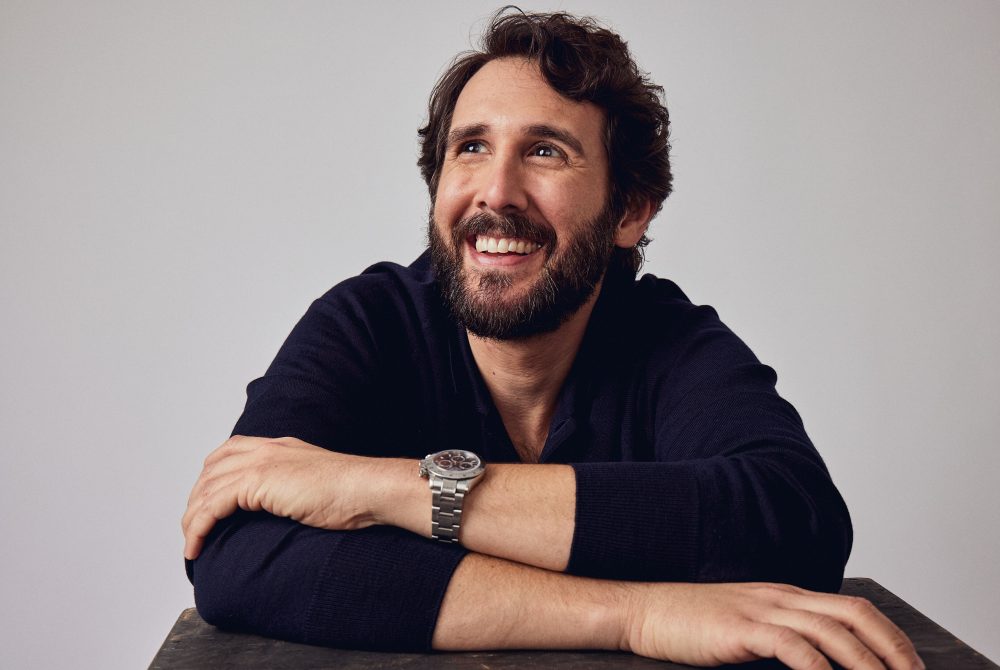
Five-time Grammy-nominated singer, songwriter and actor Josh Groban has built a career on his powerful voice and emotive performances, making him an important figure in classical crossover with hits like “You Raise Me Up” and “To Where You Are.”
Alongside his music, he has channeled his success into philanthropy, launching the Find Your Light Foundation in 2004. The organization is dedicated to ensuring that every student has access to high-quality arts education, combining direct support for programs with advocacy and outreach. Over the past two decades, the foundation says it has reached more than a million children across 37 states, funding initiatives that foster creativity, self-expression and resilience. Joining Groban at the foundation is a small staff, as well as an all-family board of directors: his father Jack, mother Lindy and his brother Chris.
Each year, the foundation celebrates its work with the annual Find Your Light Benefit Concert for Arts Education. This year’s event took place on Oct. 8, at the Appel Room in Jazz at Lincoln Center in New York, featuring performances from the likes of Norah Jones and Terence Blanchard, and appearances by Elmo and Ernie from “Sesame Street.” The evening also honored authors Susan Magsamen and Ivy Ross, whose book “Your Brain on Art” explores the connection between creativity and learning.
The event, as well as the recognition of Magsamen and Ross’ work, was especially resonant given the long-term decline of arts education throughout the U.S. amid chronic underfunding — realities this year’s cuts to government funding for the arts will only exacerbate. Last year’s concert raised $1.4 million to support arts programs nationwide. This year, the event raised a benefit record of $1.5 million.
Ahead of the benefit, Groban spoke with Inside Philanthropy about the journey of his foundation, the impact of arts education, and why giving young people a creative outlet can be life changing. The following conversation has been edited for clarity and length.
Could you start by telling me a little bit about some lessons in philanthropy you had growing up? What was your idea of philanthropy before you formally engaged in it?
Sure. Well, for me, I grew up in an incredible family environment and had incredible teachers. This was my first introduction to understanding what education, and especially arts education, meant. My mom was an arts teacher and enjoyed teaching for most of her life, and now we all work on the foundation together, but early on, when I got into performing — and that started very, very young with [producer] David Foster around 16 or 17 — we traveled the country together and performed at different philanthropy galas.
I just started cutting my teeth — we were lending ourselves to these organizations, singing and learning a lot about the art of philanthropy and what it takes, and learning about different causes and how important it is. But then in my work, realizing that having a table of people that wanted to go beyond just listening to the music, that wanted to also give back and also use their enjoyment of my music to be a platform for them to figure out how they can give back, as well. It was hugely inspiring, and then, of course, starting a foundation takes a lot more effort. But I’m very proud and very lucky that for the first half of my life, and the first half of my career, I just got to lend myself to whoever needed it.
It’s been more than two decades since you started Find Your Light. What was going on for you when you started the foundation? And how do you assess everything that’s happened since in terms of impact?
It started with just a huge act of generosity from my fans. They came up to the stage during a concert, sometime around 2004, I think, and they offered me a jumbo check for a lot of money that was raised through auctioning off autographs and all kinds of other things. And they said, “Hey, one day, we’d love to see you start a foundation, and if and when you do, we’d like this to be the first donation.”
So I immediately just kind of started something called the Josh Groban Foundation, which we could turn into a 501c3, we could collect this money as donations, and we could give it to other organizations that needed it. We were an umbrella organization that really gave a little bit to a lot of places: poverty and medicine, homelessness, and also all around the world, different places that we were giving to. But it was unfocused. We didn’t necessarily have a mission statement.
At some point, around 2011, I was asked to testify to Congress about the importance of the arts in our world and in our country. And realized, as I’m sitting there with Linda Ronstadt and Wynton Marsalis, and I’m listening to them give these brilliant speeches, and I’m so honored to give a speech of my own. I said, this is something that feels like a silver bullet for me. This is something that I have a lot of personal experience with. And I think I’d like my focus to be on what not only saved my life, but where I feel I could be best of service with my own personal experience, to those communities in the United States that are always at risk of losing those programs. Careers can ebb and flow. I wanted the foundation to be the foundation regardless of whether I had a hit or not. We’ve been doing it for many years now, and over the decade, we’ve given something like $6 million to hundreds of organizations across the country, reaching over 1 million kids in 37 states. And we’re very proud.
You’ve been navigating this space for quite some time now. What sorts of takeaways do you have, and what do you think philanthropy can do to be a better ally to arts organizations on the ground?
First of all, one of the things we’ve learned is that you have to roll your sleeves up, and you got to do the hard work. That, like anything that’s worthwhile, it takes time. We’re now entering our second major gala performance at Jazz at Lincoln Center after almost 20 years of fundraising and connecting and finding out where the need is. We’ve been listening, reaching out to programs, to principals, students, communities, and finding out what they need and where we can best enrich what we call arts education deserts.
It’s people to people. It’s person to person. It is about really getting in and learning and doing what you can from the ground. The other thing is that philanthropy is hugely collaborative. We are so lucky that we get to join forces with other organizations and other missions that are so similar to ours, and that there is not any competition here. We are all on a superhighway to reach as many kids as we can and we help each other. That is something that, especially coming from the entertainment industry that can be very hyper-competitive, philanthropy is the opposite of that, and it has been a really wonderful thing to see.
As far as the impact, we’ve never felt more of a call to action than we feel right this minute. I know we say that every year. But it truly is more important than ever. With the government cuts, with the arts leaving our schools at a critical time, it’s more important than ever that we really put across two things of vital importance: One is that the math is on our side about how the arts enriches young people’s minds, regardless of if they want to go into this professionally. But also, two, it’s the antidote to division and to divisiveness.
Related Inside Philanthropy Resources:
For Subscribers Only
Do you have a particular story or anecdote of someone you’ve impacted, whether an organization or a young kid?
Just recently, we felt a call to action during the L.A. fires, and there were programs that we were able to directly impact, like the Last Repair Shop, which was the subject of an amazing documentary. The Music Rising Disaster Relief Fund was another one, making sure that those schools that were affected by the fires were able to get funding they need to restock and be able to continue those programs. Similarly, during COVID, we really felt like we had to get creative.
On a more person-to-person scale, there was a young girl that I met at a place called [Chalmers STEAM Elementary School-Chicago]. The school is part of a program that we support called Turnaround Arts, which was implemented by Michelle Obama and is about taking schools that are in need of renovation in every sense of the word and giving students there a robust arts education. There was a little girl that was really precocious. But she was inches away from being expelled because she had behavioral problems. She was a back-row kind of kid. But all of a sudden — and it sounds woo woo — she gets a musical in her hand, she gets the opportunity to be in “Annie,” and she’s using the preciousness and energy and she realizes there’s an outlet for this called music and acting and singing.
I have a similar story where I was about to flunk out of school. I had ADD and was having a hard time socially, but I had that teacher who unblocked the music room, allowed me to come home with a more confident and assured sense of self.
You have this new project coming out, “Hidden Gems.” Can you tell me about that?
Sure. I released a compilation album called “Gems” a few months ago that was essentially a playlist of some of the songs that meant the most to me and meant the most to my fans, and put them all in one place after 25 years, which was a lot of fun to kind of curate. And we realized that, over the course of recording hundreds of songs, you record stuff that is for a bonus edition, for a Hallmark thing or a Target thing. You realize that there was this really good stuff that just came out for a small amount of time and never made it to streaming. So we’re releasing “Hidden Gems” in November.
What’s it like engaging in philanthropy with your family?
It’s the most meaningful thing I’ve been able to do in my life, frankly, embarking on this journey with my brother, my mom and my dad. My brother, who’s a filmmaker, is able to also tell stories about these schools. We’re a small organization lucky to be able to do big things. We have two employees. The goal, of course, is to keep expanding. But our size has also been our strength, because our overhead is so small. So when we’re able to raise millions of dollars, the vast, vast majority of that goes straight into the hands of those that are asking for it every year. So that’s been fun.
Looking ahead, what are some of your biggest hopes for the foundation going forward?
Well, as I said, we’d love to keep growing and keep saying yes to grantees. We’ve been so lucky that we have angel donors. We have people who really make sure that whenever we do an event, we make every dollar go right to the foundation. They underwrite every event we do. People like Fran and Paul Turner [arts patrons and Find Your Light Foundation donors], and Cindi and Curtis Priem [a tech couple who are longtime donors and event chairs]. They’re amazing. So continuing to make friends that understand our mission is important.
And then I’d also say — especially given the state of the world right now — and how you see in a number of different countries, where governments are battling each other while the people suffer, to be able to take this kind of work globally and to be able to connect students internationally to each other through the power of the arts is something that is a personal goal of mine that I think would be really, really a wonderful thing. There is more dehumanizing going on in the world than I’ve seen in my lifetime, and we need a humanizer. We need the arts to connect kids to other kids.
