





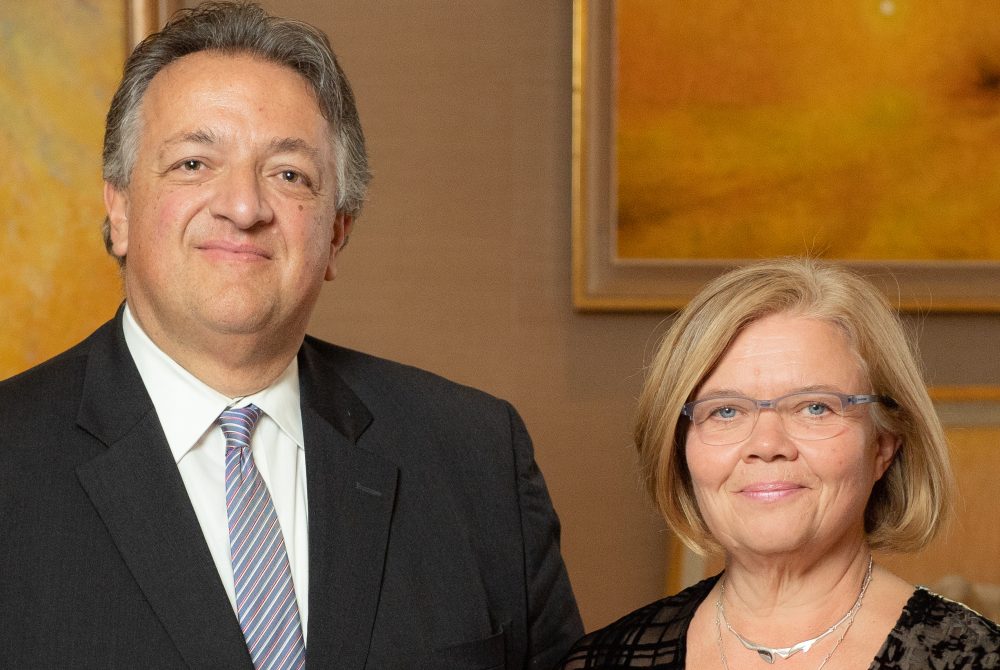
Sixty-three-year-old Noubar Afeyan, currently worth $1.9 billion according to Forbes, is the founder and CEO of life sciences innovation firm Flagship Pioneering. He’s also the chairman and cofounder of biotech firm Moderna, known among other things for its COVID-19 vaccine. The biotech entrepreneur has helped start more than 70 public and private healthcare and life sciences companies.
Afeyan, whose grandfather survived the Armenian genocide, was born in Beirut before going to high school and McGill University in Montreal, where he received a chemical engineering degree in 1983. He then moved to the U.S. and earned his Ph.D. from MIT.
Though the Afeyans have historically kept a low profile in philanthropy, Noubar and his wife, Anna Afeyan Gunnarson, stepped into the spotlight this past summer by signing the Giving Pledge. Through the Afeyan Foundation, the couple supports science, education and global humanitarian initiatives. In 2015, Noubar also cofounded the Aurora Humanitarian Initiative along with Vartan Gregorian and Ruben Vardanyan, a project born of the Armenian diaspora’s historical trauma, and designed to shine a global light on modern-day humanitarians.
In late September in New York, Aurora announced the four finalists for its $1 million Aurora Prize for Awakening Humanity, which recognizes humanitarians whose courageous actions have improved millions of lives worldwide.
The Afeyan legacy is already moving into the next generation, too. The couple’s daughter Armine Afeyan, a Yale alumna, serves as CEO of the Aurora Humanitarian Initiative and continues to sharpen the family’s mission. IP recently spoke with Noubar, Anna and Armine to explore the personal motivations behind the Afeyans’ philanthropy — from their Armenian heritage to their local Boston initiatives — and how the Aurora Humanitarian Initiative is spotlighting heroes who make a real-world difference.
The Afeyans’ international roots and early lessons in giving
While Noubar and Anna Afeyan now call Boston home, their outlook on life and philanthropy has been deeply shaped by international roots. Born in Sweden, Anna began her career in industrial process engineering before moving to the United States. She says that in Sweden, society basically took care of basic needs for everyone, so coming to the states was a big culture shock in terms of the role of private giving. But while Sweden may not have the same formalized system of philanthropy as the U.S., she says that her parents did model a kind of charity.
“My parents used to invite for Christmas people who had come in as new immigrants. You don’t pay much attention to it [because] you’re little. But it becomes something that you understand is a good thing to do — to include everyone,” Anna said.
Noubar’s own story is also rooted in migration and survival. A descendant of Armenian genocide survivors, he was born in Lebanon to a father from Bulgaria and a mother whose family had escaped to Beirut. “I was born at a time when this overhang of an unrecognized genocide and all the displacement that happened was pretty alive and felt,” Noubar said.
His parents, he said, likely would have given back if they’d had the means. Instead, he grew up surrounded by a strong Armenian community in Beirut that focused on awareness and empowerment of the diaspora. His own urge to engage in philanthropy emerged in the early 1990s, after he and Anna married, as the newly independent Armenia faced immense poverty following the collapse of the Soviet Union. Still in his 30s, Noubar began supporting relief and rebuilding efforts in Armenia after the 1988 earthquake and helping to build schools in his ancestral homeland.
If the first step for Noubar was focusing on the survival of Armenia, then the next step was focusing on its revival. By the early 2000s, those efforts evolved into more structured development projects, often in collaboration with other Armenian philanthropists. Among them is billionaire investment banker Ruben Vardanyan, with whom he co-launched Armenia 2020, which commissioned extensive research into key aspects of Armenia’s future development, and the Initiatives for Development of Armenia (IDeA) Foundation, a charitable organization incorporated in Armenia that carried out more than $550 million in projects between 2007 and 2017.
In 2008, the billionaire pair also cofounded the National Competitiveness Foundation of Armenia, a public-private partnership aimed at strengthening the country’s economic growth. Through these ventures, Afeyan worked closely with Armenian government leaders to help shape national development priorities. The couple have also engaged in what he calls “psychosocial revival projects” — he launched the Armenian Spiritual Revival Foundation to assist people in recovering from mental health challenges associated with post-war and post-crisis environments.
How the Afeyans ramped up in the Boston area and brought in the next generation
In 2000, the Afeyans established the U.S.-based Afeyan Foundation to formalize their philanthropy, which focuses on education, science and technology, and humanitarian action. The couple began in Armenia, where they also focus on education projects, healthcare, and more recently, technology and AI.
While Noubar focused internationally, Anna turned her attention closer to home. After spending time raising their children, she began looking for ways to address educational inequities in their own community and found that the most pressing needs weren’t in their immediate neighborhood, but in inner-city Boston. That search led her to Beacon Academy, which serves students from under-resourced school districts. The program begins with a gap year before high school, during which students attend full-time classes to get their academics on track. From there, Beacon helps them secure full scholarships to private schools and continues to provide guidance for the next decade as they continue through college and into the workforce.
“So any time there’s something happening that might cause them to drop out, there’s adults there and support there in key moments,” Anna said.
In addition to her role as a donor, Anna also taught science at Beacon Academy and still serves on its board. Over the past 20 years, she’s watched the nonprofit evolve and its students thrive. Some students have gone on to intern at Noubar’s Flagship Pioneering. And when the couple celebrated Flagship’s 25th anniversary, Anna ran into one of her former students who now works for Ring. “That’s what makes it all worth it. Beacon is the local organization I feel most deeply connected to,” Anna said.
The Afeyan Foundation, which held around $10 million in assets and gave away nearly $3 million in the 2024 fiscal year, moved some its largest donations that year to Friends of McGill University ($400,000), Armenian General Benevolent Union ($250,000), MIT ($200,000), and Beacon Academy (a combined $215,000).
The Afeyans eventually brought their four children into philanthropy, something they say was a gradual process. “The foundation board started with a text group,” Anna said, with a smile. Eventually, this extended to quarterly meetings with a small staff added to the mix. The second generation has a smaller amount of funds they can use to make their own annual grants. They can also come to the board meetings with ideas and areas of interest, and suggest larger grants. Anna says the couple are still thinking about how the foundation will continue beyond them.
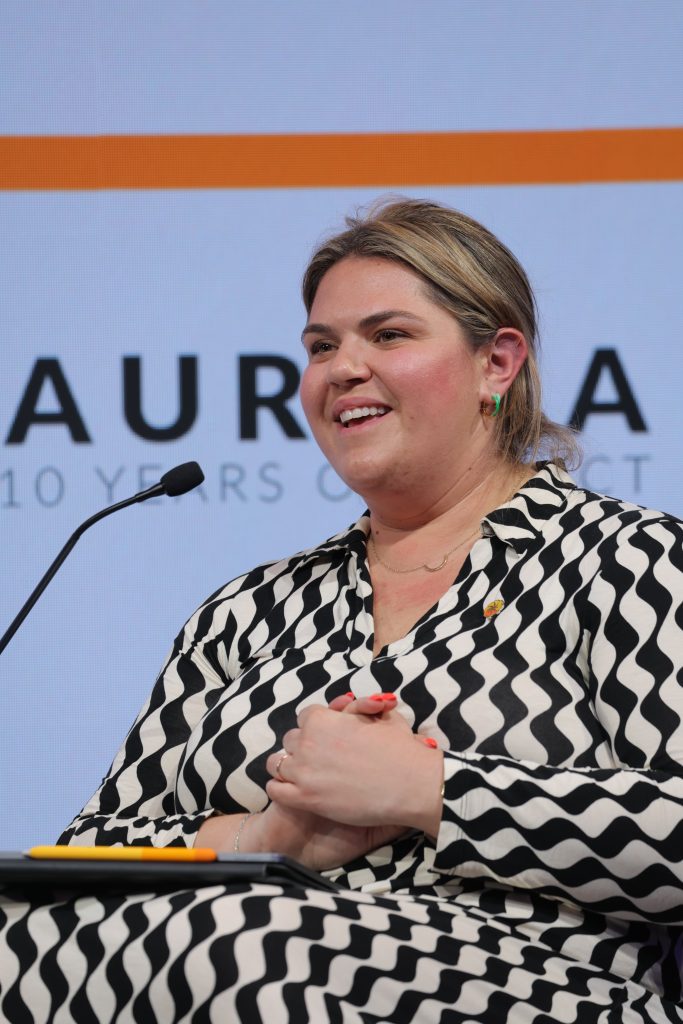
The Aurora Humanitarian Initiative gives humanitarians a chance to give back
Noubar Afeyan calls the Aurora Humanitarian Initiative, its founding correlating with the 100th anniversary of the Armenian genocide on April 24, 1915, the largest single project they’ve initiated. He says that too often, we tend to think of humanitarian projects as an institutional, almost industrial complex, largely fed by governments and gargantuan donors. “But the humanitarians themselves can be really anybody who steps in and saves people’s lives or improves people’s lives,” Noubar said.
This is the thrust behind Aurora, which is now celebrating its 10th anniversary and set to host the four finalists for the $1 million Aurora Prize for Awakening Humanity, chosen from a global nominations pool of more than 800 humanitarians.
For CEO Armine Afeyan, Aurora represents both a family legacy and a calling. The first in her family born in the U.S., she describes growing up with the idea that privilege came with responsibility. “It was just kind of an expectation growing up that to those who much is given, much is expected,” she said.
Armine first visited Armenia with her father in 2003 while he was working on development projects there. “I was in middle school and it was incredibly formative,” she said. “I wouldn’t have known — how would any kid know? — that national planning is an activity. Seeing that completely colored what I went on to do.” She studied political science at Yale, focusing on post-Soviet development and Armenia in particular, before spending more than a decade in the private sector. After earning her MBA from INSEAD, she joined Wayfair, where she held several international roles.
By 2023, the timing was right for her to return to the family’s philanthropic work full time. Having helped launch the Aurora initiative during its founding year, she returned as CEO just as the organization decided to extend its mission beyond its original eight-year plan.
Armine describes Aurora as a platform for recognizing ordinary people performing extraordinary acts, or better yet, “someone who risks their own life to save others,” she said. “From my family’s story, it’s my great-grandfather and his brother being pulled off a train by a German officer [who saved them]. That German officer has descendants now who have no idea what happened then, but better yet, he has spiritual descendants in the people who do that work today so that 100 years from now, there are others who can feel grateful.”
Under her leadership, Aurora has expanded its reach to 64 countries, supporting more than 400 projects. Its nomination process remains open to anyone, anywhere.
She’s especially proud that Aurora embodies a kind of trust-based philanthropy that gives agency to the humanitarians. The Aurora Prize is structured to give recipients the chance to become funders themselves: Laureates receive a portion to advance their own work, while also determining how the remaining funds are distributed within their communities. It’s an approach that reflects both the family’s emphasis on local knowledge and their belief that those closest to the challenges are best equipped to drive lasting change.
Related Inside Philanthropy Resources:
For Subscribers Only
The Afeyans sign the Giving Pledge and look ahead
For the Afeyans, signing the Giving Pledge in May 2025 was less a grand gesture than a natural continuation of how they’ve long approached philanthropy. “Much of the means that we have been fortunate to receive are going to be directed to do good on the planet and not kept within the family,” Noubar said.
Anna noted that one of the most profound lessons of Aurora has been seeing how laureates, often working in the most difficult conditions, identify and fund local organizations they know are making an impact. That process has, in turn, helped the Afeyan Foundation discover new causes and partners around the world.
Looking ahead, the couple describes their philanthropic work as an ongoing cycle of “gratitude in action.” Noubar sees this as central to the future of both Aurora and the foundation: “Every time I express my gratitude in a way that infects somebody else with the need to feel gratitude, I don’t diminish my sense of gratitude, I add to the pile.”
Armine shares that optimism and reframes intergenerational trauma as intergenerational resilience. She sees that work entering a new phase, one focused on deepening connections and building resilience across generations and geographies. “We’re building out our governance function. We’re building out a team here in the U.S. … I certainly hope that it’ll be a nice long run of building gratitude and action out there. I think the world could use it,” she said.
Note (10/9/25): This article has been updated to add that Vartan Gregorian and Ruben Vardanyan cofounded the Aurora Humanitarian Initiative alongside Noubar Afeyan.
