





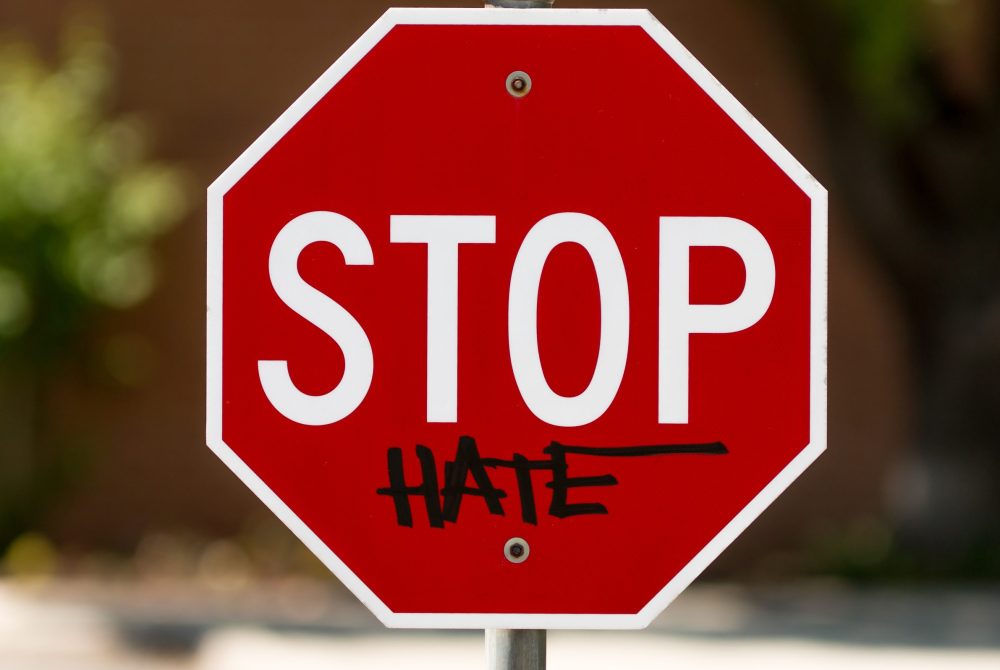
Three days after Charlie Kirk was assassinated on a college campus in Utah, an international group of advocates, business people, faith leaders, academics and others gathered 1,800 miles away in Pittsburgh, Pennsylvania, to address the ongoing struggle to prevent and heal from hate-based violence.
This year’s annual Eradicate Hate Global Summit, which was held from Sept. 15 to 17, brought a wide range of speakers and perspectives together. Keynote speaker Josh Shapiro, Pennsylvania’s Democratic governor, was introduced by former Republican Gov. Tom Corbett. Other speakers included former intelligence professionals, leaders from four of the world’s faith traditions and people from several countries, including the U.S., on the front lines of the movement to prevent and recover from hate-based violence. Session topics and speakers included an update on hate-related violence committed against people because of their “identity-based characteristics,” individuals who had backed away from violence either before or after perpetrating it, and hate crime survivors talking about their work to prevent others from being victimized in the future.
The Eradicate Hate summit itself benefits from philanthropic supporters including, this year, the Richard King Mellon Foundation, the Jones Day law firm and the Jones Day Foundation, the Heinz Endowments and the Fine Foundation. Look more broadly, however, and there are clear signs that nonprofits focused on preventing and healing from violent hate crimes are facing severe threats to their funding even as hate-based violence remains a deadly problem in the United States and abroad.
Every quarter, said Bedrock President Ryan Greer, his organization asks its 67 partners what their top priorities and challenges are. Bedrock was founded about two years ago to combat hate-fueled violence in the U.S. and support organizations pursuing that mission. “And every quarter, they tell us their top challenges here in the U.S. are resourcing related. … Almost always, our partners will tell us fundraising is their top challenge,” Greer said during a session called “Shared Priorities: Aligning Practitioners and Funders,” a transcript of which was provided to Inside Philanthropy by Eradicate Hate.
“Think about that for a second,” Greer continued. “When faced with the question, essentially, of ‘is it harder to counter Nazis or fundraise?’ American practitioners will tell you: fundraising.”
The problem, Greer said, is compounded by the fact that, in the U.S., 64% of funding for the prevention of hate and political violence comes from the federal government. Those funds have evaporated. The Trump administration has cut funding for programs including terrorism prevention, gun violence prevention and hate-crimes-related training, further heightening the need for philanthropy to step up. Greer also said that internationally, other nations’ governments are tightening their belts in response to widespread economic upheavals, leaving less funding to combat hate-fueled violence abroad.
Related Inside Philanthropy Resources:
For Subscribers Only
Philanthropy’s role in combatting hate-fueled violence: the bottom line
Eradicate Hate and its global conference were launched in response to the Oct. 2018 massacre at Pittsburgh’s Tree of Life Synagogue. According to the organization’s website, “Eradicate Hate’s organizers refused to be defined as victims of hate. Instead, we resolved to use the Tree of Life attack as motivation to launch the most significant anti-hate rule of law initiative in the world.”
Bringing together multi-sector leaders and people with direct experience of a problem and possible solutions to learn from and network with each other is a powerful approach. That may be particularly true in the world of hate-related violence prevention; there is, after all, greater strength in numbers, and those who foment and perpetrate hate crimes would no doubt prefer their targets remain isolated and fearful.
Now would be a good time to note that the funders and nonprofit organizations working to confront hate — like those working to tame toxic polarization — aren’t ideologically uniform. Most hate crimes here in the U.S. are perpetrated by right-wing extremists, and even right-leaning think tanks like the Cato Institute have found that more deadly domestic political violence stems from the right than the left, contrary to recent claims by the president and the vice president. But as Kirk’s killing and the assassination attempts on then-candidate Donald Trump prove, anyone is a potential victim no matter their politics.
As with so many areas where today’s federal government is falling short, there’s ample precedent for philanthropy coming to the aid of organizations on the front lines in the struggle against hate-based violence: For instance, funders responded to anti-Asian hate crimes during the COVID-19 pandemic and have supported work to counter anti-trans hate. Of course, addressing antisemitic hate is another area where funders have been active. Nor is Eradicate Hate the only organization that received philanthropic funding after the Tree of Life tragedy. In 2023, Inside Philanthropy reported on philanthropies supporting the production of a film by nonprofit Not In Our Town, which recounts how a diverse group of Philadelphians came together to stop hate in their community in response to the Tree of Life attack.
These days, philanthropy is being called on to protect a nonprofit sector that’s in crisis on virtually every front, thanks to a combination of federal funding cuts and right-wing antipathy to a democratic civil society itself, not to mention the 14 million people who will probably die in the next five years thanks to the destruction of USAID. In a time of such deep and widespread upheaval, it’s extremely difficult to figure out which dire situation to address first. That’s true for individual donors, and equally difficult for foundations that are themselves racing to put out fires while they are simultaneously under attack.
At the same time, the bottom line to success against any of the multiple threats we’re confronting is that the people working to address those problems need to remain alive and whole to do so. With that in mind, our country’s major funders may want to strongly consider supporting work intended to make that possible.
