





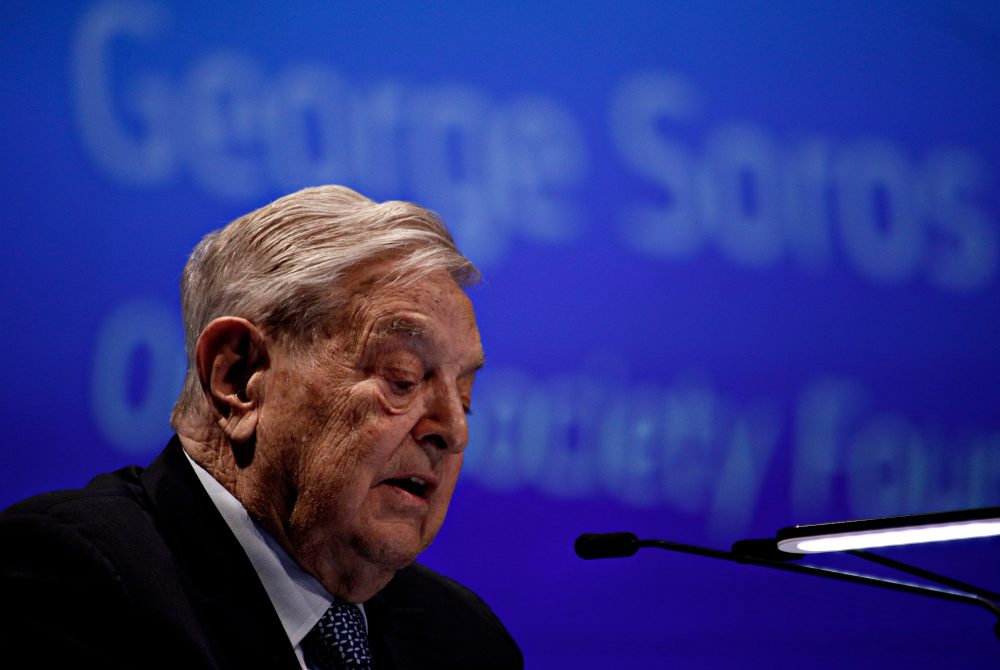
Last week, in yet another extraordinary move, President Donald Trump reportedly ordered the Justice Department to investigate George Soros’ Open Society Foundations. The purported investigation appears to have been informed, at least in part, by the Capital Research Center, a philanthropy-backed, 501c3 watchdog organization that calls itself “America’s investigative think tank.”
The Capital Research Center (CRC), which was established in 1984, focuses on the work of foundations, charities and nonprofits, examining how these organizations “spend money and get involved in politics and advocacy, often in ways that donors never intended and would find abhorrent,” according to its website. This is a nod to conservative philanthropy’s longstanding concern with donor intent. One wonders, however, what the conservative donors of yesteryear, so concerned with limiting government power, would think about how the Trump administration is using CRC’s research.
When it broke the story of the apparent investigation of OSF, the New York Times reported that a Justice Department official had pointed to a CRC report “as evidence for such investigations.” In a later article, the Times characterized the targeting of OSF as “part of a broader effort by the Trump administration to cripple the financial and organizational infrastructure supporting Democrat-aligned causes and candidates.”
Last week, Trump also signed a presidential memorandum that aims to establish “a new law enforcement strategy that investigates all participants in these criminal and terroristic conspiracies — including the organized structures, networks, entities, organizations, funding sources and predicate actions behind them.”
It seems clear that the administration intends to embark on an unprecedented campaign to silence and punish a broad range of philanthropic funders it doesn’t like — or at least to create the perception that this is its goal. CRC’s research appears to be at the center of this campaign.
CRC President Scott Walter acknowledged that CRC tends to focus more on organizations he characterized as “left.” As he said in a recent interview, “While we do cover both sides, I admit we report more on the left because it’s so badly under-covered by mainstream media.”
A sampling of CRC reports includes “The Rocky Mountain Institute’s climate and DEI colonialism in Africa,” “The Ford Foundation spends $20 million per month on lefty advocacy,” and “When Charities Betray America: How ‘Pro-Palestinian’ Protest Groups Promote Anti-Americanism.” Just this week, CRC unveiled a new report, “The MacArthur Foundation helps violent criminals stay free.”
CRC’s Walter also wrote a book about the philanthropy consulting organization Arabella Advisors, titled “The Dark Money Network of Leftist Billionaires Transforming America.” In August, the Gates Foundation internally announced that it would no longer be working with Arabella, a move that Walter attributes, at least in part, to CRC’s research. “Gates’ decision is a sign of more to come,” Walter wrote in The Hill. “It suggests that conservative pressure tactics are sometimes able to tame big philanthropy.”
CRC also runs Influence Watch, which provides summaries of “public policy influencer” organizations — on the left, right and in between — offering information on each group’s history, goals, funding and controversies in which they’ve been involved. CRC is backed by many longstanding conservative foundations and donors. They include the Lynde and Harry Bradley Foundation, the Sarah Scaife Foundation, the Diana Davis Spencer Foundation, the John William Pope Foundation, the William E. Simon Foundation, and the sunsetting Searle Freedom Trust, as well as anonymous support through DonorsTrust, the conservative DAF sponsor, as well as through DAFs at places like Fidelity Charitable.
According to the New York Times, Walter has recently briefed senior White House officials “on a range of donors, nonprofit groups and fundraising techniques.” As Walter told IP, “I briefed them on our research, which is always public. I know it would make a wonderful novel if I were secretly plotting with some White House official, but I’m not. I’m just giving people our reports and answering questions.”
The Trump administration’s campaign against the Open Society Foundations isn’t a surprise: George Soros is a well-worn target of the right, and J.D. Vance has been a critic of progressive philanthropy since before he became vice president. Since Charlie Kirk’s assassination, both the vice president and the president himself have stepped up their rhetoric against progressive funders — specifically the Ford Foundation and Open Society Foundations. They have included these progressive funders in what White House Deputy Chief of Staff Stephen Miller has called “a vast domestic terror movement” that they blame for Kirk’s murder — even though officials have repeatedly said they believe the alleged shooter acted alone.
CRC’s report on Soros’ Open Society Foundations
The Capital Research Center’s Soros report, which was published last month, is headlined “Exclusive: Soros’ Open Society gave $80 million to pro-terror groups.”
Ryan Mauro, the CRC investigative researcher who wrote the report, described its findings in detail when he appeared with Glenn Beck on the Charlie Kirk Show, which Beck guest hosted shortly after Kirk was killed.
“We had some amazing findings, according to George Soros’ own files from his Open Society Foundations,” Mauro told Beck. (According to the report, CRC obtained the information from the Open Society Foundations’ grants list.) “Myself [and] my colleagues at Capital Research Center basically went through as many grants [and] as many funding streams as we could find. And here’s the smoking gun that we believe that President Trump, if he’s informed of it, can use to go after Soros’ network of hate in various ways,” Mauro said.
According to the report’s introduction, “Since 2016, George Soros’ Open Society Foundations (OSF), now run with his son Alexander, has poured over $80 million into groups tied to terrorism or extremist violence.” The report continues, “This investigation documents how Open Society’s philanthropy blurs into complicity — fueling groups that celebrate violent uprisings, train militants and endorse terrorist movements. The findings raise urgent questions for Congress, federal investigators and the IRS about whether Soros’s flagship foundation, and its grantees, can continue to operate with tax-exempt status while bankrolling criminality at home and sanctioned entities abroad.”
To back up these broad claims, CRC identifies groups that advocate for a variety of causes — including human rights, Palestinian rights, racial justice and climate protection — and attempts to link them to terrorism in some cases, and to violent protests in others.
But the evidence the report provides to bolster its arguments is often thin and relies on guilt by association without solid evidence of actual criminal or terrorist actions on the part of either OSF or its grantees. It uses charged language, like that in the introduction above, to characterize the organizations’ behavior and goals. To back up its claims, it frequently points to CRC’s own materials or to publications by outlets with right-wing agendas of their own, like Front Page, an online news site published by the late conservative David Horowitz.
The report describes OSF grantee Al-Haq, a Palestinian human rights group based in the West Bank, as being “long accused of ties to the Popular Front for the Liberation of Palestine (PFLP), which the European Union and the United States designate as a foreign terrorist organization.” When IP asked CRC’s Scott Walter about those alleged ties, he pointed out that human rights activist Shawan Jabarin, who heads Al-Haq, previously worked with PFLP.
Princeton Professor Kenneth Roth defended Al-Haq, with which he is familiar as the former executive director of Human Rights Watch. Roth acknowledged that Al-Haq is one of six Palestinian organizations that the Israeli government has designated as supposed terrorist groups. “But the Israeli government bandies about accusations of terrorism the same way it tries to silence critics with false allegations of antisemitism,” Roth wrote recently in The Guardian. “I have worked with Al-Haq throughout my career and have always known it to be a fact-based, principled and peaceful organization that fairly and objectively investigates and reports on Israeli abuses in extraordinarily difficult circumstances.”
In another example, the report cites a guide created by several OSF grantees, “The Black and Palestinian Solidarity Organizing Toolkit” (previously accessible as a Google doc, the guide is no longer publicly available). According to the report, the “pro-Hamas” guide “glorifies the October 7 terror attacks in Israel.” The report points to what it describes as “a glorifying image of a Hamas paraglider associated with the October 7 attacks with the words ‘Black Liberation for Palestinian Freedom’ above it.” In fact, the guide never mentions Hamas or the October 7 attacks. The “glorifying image” is a small picture of a figure ascending a barrier holding a Palestinian flag and what may be a paraglider handle — an actual paraglider is not evident in the frame. The actions the guide recommends are neither illegal or even menacing, and include the following: “Organize a speak-out at your elected official’s office”; “Hold a movie night in your community”; and “Make calls to congress every Tuesday and Wednesday.”
Claims that George Soros pays people to protest have been common in right-wing circles for some time, and the CRC report also appears to equate demonstrations and civil disobedience with violence, vandalism and property damage, without providing evidence that OSF-funded groups directly promote or engage in such activities.
Referring to another OSF grantee, the Center for Third World Organizing, the report states: “The center offers training for ‘direct actions,’ a term that is used to refer to confrontational and usually violent and destructive protests.”
Even when spontaneous violence or vandalism does occur at a protest — as happens at times — it’s a stretch to imply the funders of groups that helped organize such protests are somehow responsible. If that were the case, then donors who contributed to MAGA organizing efforts could be held somehow responsible for the violent destruction and assaults on police at the Capitol on January 6, 2021, for example.
Interpreting every line in the report and analyzing every action taken by the organizations CRC highlights goes beyond the scope of this article, and some of the materials it links to are no longer accessible online. But an initial reading raises questions about the evidence upon which the Trump administration may be basing its investigation of the Open Society Foundations.
Nevertheless, Ryan Mauro, the report’s author, is clearly confident in his analysis — and doesn’t intend to stop with OSF. When he teased the report on The Glenn Beck Program shortly after Kirk’s assassination, he made this pronouncement: “I think it’s safe to say that today, the counter-offensive begins.” Mauro also had this warning for other funders: “All the other big billionaire-funded organizations out there that are funding this type of filth, that are poisoning American civil society and spreading this type of hate that resulted in what happened a week ago — you’re on notice.”
In another conversation, Beck asked Mauro how long he thinks it will take the Justice Department to act. “The impression I get is that it’s very urgent, and Trump is definitely demanding immediate action, and he’s not the most patient man in the world,” Mauro said. “I think if it’s fully grasped what can be done through the Treasury Department and IRS with the tax-exempt situation, and if they were to have a meeting with folks who study this, like Capital Research Center and myself, it would not be hard for us to deliver the damning evidence that they need against organization after organization after organization. And one day, you’ll just start hearing about dozens of groups and then dozens more groups having their statuses removed… It would be quite the fight, but well worth it — and one that I believe we would win.”
Related Inside Philanthropy Resources:
For Subscribers Only
Defiance from OSF and allied funders, silence from conservative philanthropy (with one exception)
In response to reports that it could be investigated, OSF has remained defiant. George Soros’ son Alex Soros, who chairs its board, has reportedly said that the philanthropy would back down from its human rights work “over my dead body.”
In a recent interview with IP, an Open Society Foundations representative said that CRC’s report “engages in an exercise of guilt by association. This is an attempt to mischaracterize what Open Society does and to paint the organization as somehow sinister and shadowy and responsible for violent acts, whereas actually, we’re very open about the work that we do.” He went on, “We’re very clear that we stand for human rights, the rule of law, democracy and justice. Actually, all the work has been about upholding the rule of law domestically and internationally. OSF condemns violence in all its contexts.”
A number of funders are backing up Open Society Foundations and have spoken out in opposition to the Trump administration’s actions, as IP reported last week. But it’s notable that conservative philanthropy has been mostly silent about what seems likely to be an unprecedented exercise in big-government intrusion into the civic sector — one that it would vociferously oppose in any other circumstance.
One sector champion, the Philanthropy Roundtable, which has long defended donors’ philanthropic freedom to give just about however they want, emphasizing private giving’s important role in civil society, has to date remained silent. When we reached out about the Trump administration’s reported criticisms of Open Society and Ford, a representative said the Roundtable is “not commenting on this issue at this time.” A scan of the Roundtable’s recent posts and publications suggests it is reaching for an updated definition of philanthropic freedom this year: nonprofit freedom from government support.
When IP contacted the Lynde and Harry Bradley Foundation, representatives also chose not to comment. The Bradley Foundation has been one of CRC’s top funders, and is also typically one of philanthropy’s foremost proponents of limited government. On its website, Bradley lists the following as its first “principle”: “Fidelity to the Constitution, with its principles of limited government, federalism, separation of powers, and individual liberties.” Bradley continues: “The foundation stands firmly opposed to forces that would wrest control from individual citizens and instead vest authority in government, especially the national government.”
Considering the fact that Bradley has given CRC millions in grants over the years, one wonders how its leaders would square that with Mauro’s “counter-offensive” — and whether they’d concur with CRC that a grantmaker’s positions and actions should be considered, in effect, indistinguishable from those of its grantees.
At least one voice affiliated with CRC’s donors has raised a note of concern. Lawson Bader, president and CEO of the conservative DAF sponsor DonorsTrust, has been outspoken in philanthropy’s defense. In an interview with The Free Press, Bader said that the rhetoric since Kirk’s assassination “has the potential to weaponize philanthropy in a way that is antithetical to philanthropic freedom.” He also said that “when Stephen Miller starts talking about an organized strategy against left-leaning organizations, that’s where the White House’s rhetoric gets dangerous,” and added that threatening the nonprofit status of law-abiding organizations “narrows the important boundary between citizen and state… Philanthropy is worth defending, no matter who happens to be in the White House.”
Bader makes an important point. Trump’s pursuit of progressive philanthropy could trigger a race to the bottom in which organizations with opposing views level accusations about the others’ grantees and funding decisions, and call on the government, when they can, to enforce their preferences and silence adversaries — undermining the sector as a whole. Do we want — and does the country benefit from — the government eroding constitutional rights by threatening organizations and institutions that express ideas with which leaders in the moment happen to disagree? Philanthropy — and a democratic society — can handle and is enriched by a range of ideas and attitudes, cultures and ideals.
As Bader put it, “The whole conversation needs to tone down. I think it’s going to come back to haunt us.”
