





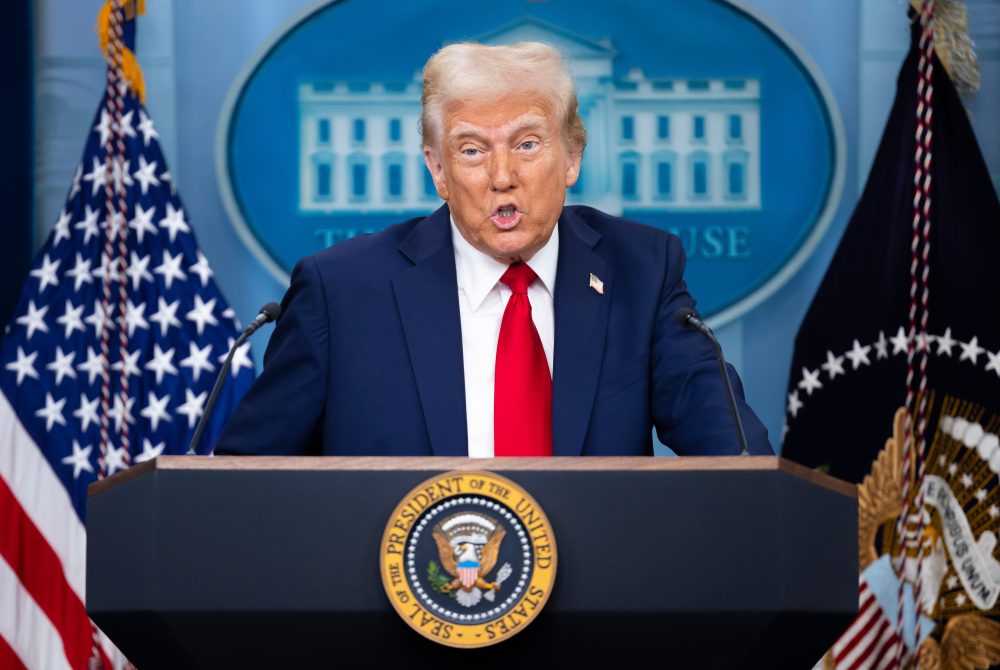
After months of threatening language from the White House and its allies, few in the philanthrosphere were surprised by reports that the Trump administration plans to investigate George Soros’ Open Society Foundations. Still, the news was delivered as the first blow in a one-two punch: The president also issued a presidential memorandum that heralded “a new law enforcement strategy that investigates all participants in these criminal and terroristic conspiracies — including the organized structures, networks, entities, organizations, funding sources, and predicate actions behind them.” Both moves raise very real concerns that the administration intends to aggressively go after philanthropic and nonprofit organizations with which it disagrees.
The response from funders was swift. A few excerpts from statements posted on LinkedIn:
- From John D. and Catherine T. MacArthur Foundation President John Palfrey: “When the federal government investigates a charitable foundation simply for giving in accordance with their beliefs, it is a threat to our fundamental American freedoms… The Open Society Foundation has the right to fund in accordance with its values, to work to strengthen democracy and uphold our constitutional freedoms.”
- From the Democracy Fund: “The reported efforts by the federal government to manufacture criminal charges against the Open Society Foundations is yet another deliberate attempt to instill fear, punish dissent, and fracture civil society. It is an affront to the First Amendment and the Constitution’s core commitment to free expression.”
- From Freedom Together Foundation President Deepak Bhargava: “The Department of Justice’s politically motivated efforts to manufacture baseless criminal charges against the Open Society Foundations are an affront on our Constitutional right to free speech and every American’s right to give and invest. It is the administration’s latest step to politicize and weaponize the federal government against groups that disagree with its policies.”
For Carmen Rojas, the president and CEO of the Marguerite Casey Foundation, which also posted a statement, the administration’s recent actions are another example of its “flood the zone” approach, which serves to overwhelm and distract.
“[Their strategy] is to shine a light away from what is actually happening in our country,” she said in a recent interview. “We’re about to experience the largest transfer of wealth from poor and working people to rich people in this country, so this administration keeps trying to shine a light somewhere else. Look over there. Look at the universities, look at the law firms. Look at OSF. This administration is creating a permission structure to steal the people’s resources and line their pockets, and they’re using any possible distraction to make that happen.”
Lawson Bader, the president of DonorsTrust, a conservative and libertarian-oriented DAF sponsor, also spoke out. “When Stephen Miller starts talking about an organized strategy against left-leaning organizations, that’s where the White House’s rhetoric gets dangerous,” Bader told The Free Press. “If an organization feels strongly about abortion or perceived income inequality, I may disagree with their motivations, but the way we battle it out is in civil society.” Bader posited a day when a different administration holds power. “We know what Trump doesn’t like,” he told the Chronicle of Philanthropy. “What might President AOC not like?”
Philanthropy-supporting organizations speak up
Other organizations in the philanthrosphere, and their leaders, also expressed concern after the administration targeted Open Society, including Kathleen Enright, the president and CEO of the Council on Foundations, and the National Center for Family Philanthropy.
Independent Sector, another key sector organization and membership group, also registered its concern. “If there is malfeasance, that can be looked at and investigated; there is an established IRS process for that,” said Jeffrey Moore, chief strategy officer at Independent Sector, in a recent interview. “Whether it’s this president or a future president, for any executive to be able to reach over that process and summarily strip away nonprofit status based on some sort of political grievance or retaliation — that fundamentally undercuts the premise on which a free society, and the First Amendment, is built,” he said.
Akilah Watkins, Independent Sector’s president and chief executive, drew a distinction between disagreement and wrongdoing in a statement on LinkedIn. “We condemn any effort to mischaracterize or intimidate lawful organizations simply because their missions challenge political preferences,” she wrote. “We must not conflate disagreement with wrongdoing. The strength of the independent sector lies in its freedom: to innovate, to dissent, and to serve communities in diverse ways. That freedom is not a flaw; it’s a cornerstone of what makes our society truly democratic.”
Disagreement around mission — versus proof of wrongdoing — is evident in the recent report on OSF published by the Capital Research Center, which the Trump administration appears to be using as evidence in its investigation of the progressive grantmaker. Despite the overheated language and frequent use of ominous terms like “terrorism”, “sabotage” and “anti-American,” CRC fails to provide evidence of actual criminal behavior on the part of the foundation or its grantees.
The president and administration officials also appear to be conflating opposition to their agenda with wrongdoing. In recent weeks, the president has warned darkly of the “enemy within,” and administration officials have invoked, without evidence, the specter of a violent, left-wing network to justify a crackdown on those with whom they disagree. In response to a recent judicial ruling he opposed, White House Deputy Chief of Staff Stephen Miller posted this: “There is a large and growing movement of leftwing terrorism in this country. It is well organized and funded. And it is shielded by far-left Democrat judges, prosecutors and attorneys general. The only remedy is to use legitimate state power to dismantle terrorism and terror networks.”
A collective response from philanthropy to deter authoritarianism
The administration’s efforts to single out George Soros’ philanthropy don’t surprise Hardy Merriman, an author and independent international democracy expert who previously led the International Center on Nonviolent Conflict and has studied pro-democracy movements and authoritarian regimes around the globe.
“Aspiring autocrats are not strong enough to accomplish all of their goals at once,” he said. “They are not strong enough to take on the sector as a whole, so the only way they can stop the sector quickly is by spreading fear. They single out a few examples and try to isolate them through attacks in the media or otherwise, and then hope that the sector gets scared enough to start censoring itself. This is a test, and for those who think that being quiet in moments like this is going to deter the administration, I would disagree. The administration is emboldened when it gets its way as a result of bullying and fear.”
That is why funders rallying to OSF’s defense is so important, Merriman said. “The best way to deter future attacks is to stand strong — early and together,” he said. “When met with collective response, the administration has backed down. I haven’t heard the administration talk much about Jimmy Kimmel since he got back on the air, and that’s because they lost and they would like us to move on as quickly as possible. Jimmy Kimmel revealed an Achilles heel of authoritarians, which is that when people get together and stand up courageously, the administration loses.”
Related Inside Philanthropy Resources:
For Subscribers Only
What else can philanthropy do?
In recent months, a number of funders have joined forces to champion the right to give, as IP’s Dawn Wolfe reported. More recently, funders responded after the administration singled out the Open Society Foundations and the Ford Foundation in the wake of Charlie Kirk’s assassination.
Merriman had suggestions for other ways funders can stand up to attacks on the sector, including increasing their spend-out rates, supporting programs that protect civil society, and stepping up efforts to work with other sectors, including civic associations, universities, unions, faith communities and other groups.
The MacArthur Foundation and the Freedom Together Foundation both increased their payouts this year, as Wolfe reported, as did the Marguerite Casey Foundation. Ashleigh Subramanian-Montgomery, acting director of the Charity and Security Network, is urging funders to do even more to support nonprofits. “We are telling the organizations we work with to be adamant with funders, that if they don’t fund us now there may not be a sector left,” she told Wired.
Independent Sector is working to help nonprofits and foundations stay informed about the latest policy changes and administrative actions through its tax and federal legislation, litigation and executive action trackers. “One of the things that nonprofit leaders need right now is a good, reliable, steady stream of information when these things come down,” Moore said. “Be it an executive order or a presidential memorandum, folks really need to understand what it says and what it means.”
Along with providing additional financial resources, philanthropy can help nonprofits by offering assistance with research, and with legal or crisis communication services, Moore said. “I think for funders, it’s super important that they’re talking to their grantees and having open communication about what the needs are,” he said. “Another thing that is critically important for philanthropy to do — and we’re gratified to see more of this happening — is to remind grantees and make it possible for grantees to use their voices as advocates for their mission areas, within the rules of what is permissible, of course.” (See the Independent Sector’s in-depth analysis of nonprofit advocacy and civic engagement).
Marguerite Casey’s Rojas is also aiming to ensure that the foundation’s investments align with the organization’s values, an effort which she hopes more funders will pursue as some private sector actors enable authoritarianism. “Many of our institutions normally give out 5%, and may have 95% of their resources invested at counter or cross purposes to their mission,” she said. “They may be invested in companies that are advancing the autocratic slide in one way or another — companies that are benefiting from our public dollars and whose leaders have shown themselves to be deeply undemocratic in their practices. Instead, we can be resources for good, creating the wind in the sails of our grant recipients by investing in economic models that don’t require exploitation or extraction.”
Meanwhile, Rojas intends to continue speaking out, and she believes others in the sector will do the same. “What we have seen over the last 10 months is a strategy of divide and conquer, and I’ve been really proud to see [a large] number of philanthropy CEOs, boards and nonpartisan organizations come together to defend the constitutionally protected rights that people and institutions have in this country,” she said. “The thing that has made me so inspired and buoyed me with hope in this moment is that in spite of differences in boards, differences in approaches, differences in issue areas, folks have come together in a resounding stance to protect our freedom of speech and our freedom to give.”
