





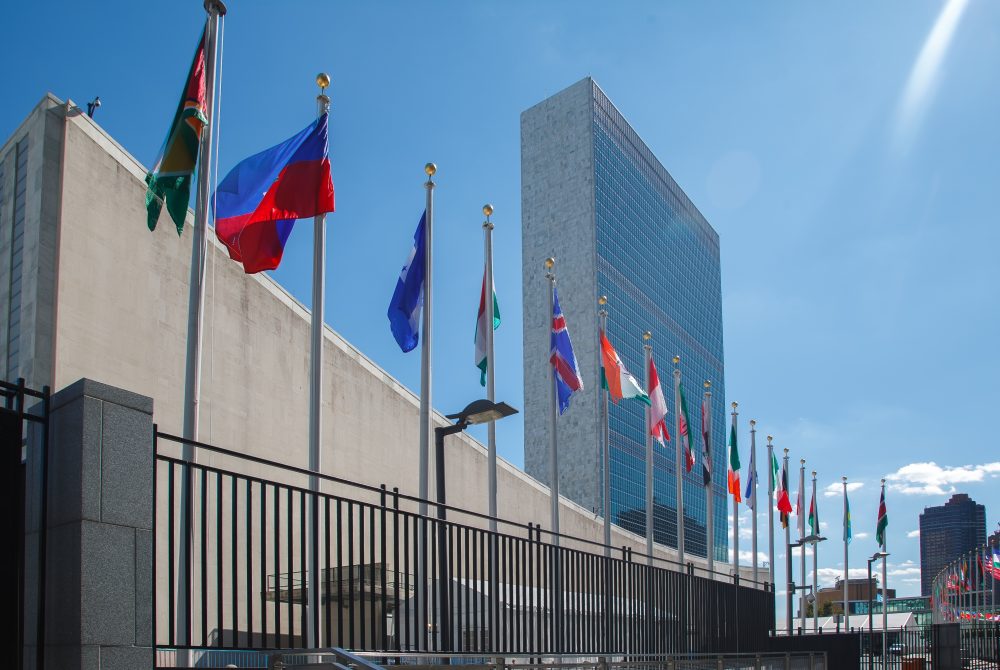
Amazon founder and Executive Chairman Jeff Bezos began his speech at Climate Week NYC by thanking the United Nations’ deputy secretary and the president’s climate envoy, then moved onto the big news: the Bezos Earth Fund would be donating $1 billion for the conservation of nature.
That was in 2021.
Today, that scene feels like it played out in another dimension. Not only did Bezos skip this year’s edition of the just-concluded climate gathering; his philanthropy has not made any such mega-pledges in years, and the current federal administration is more likely to have an oil envoy than a climate one. Instead, one of Bezos’ most recent public appearances came this January at the inauguration of President Donald Trump, who had his own speech last week at the United Nations. Key phrase: Climate change is “the greatest con job ever perpetrated on the world.”
Bezos and his fund are not the only donors who were missing in action from the headlines coming out of Climate Week this year. Foundations have long used the September occasion to announce major new initiatives and pledges. Even in years with few pledges, new partnerships or coalitions are usually unveiled. But this year, philanthropy barely made the news.
Instead, with Climate Week behind us and November’s United Nations climate conference approaching, the numbers in the air are not newly pledged dollars, but freshly published data on past years’ funding. They add up to a mixed picture of climate philanthropy.
Over the last few years, climate funding has climbed encouragingly, with billionaire after billionaire launching new climate philanthropies. Support may still have fallen well short of the scale of the challenge, but the trendline was pointed in the right direction. Now, a crop of new reports show a funding sector that is growing in places, but struggling to match the pace or promise of earlier years. With evidence mounting that billionaires are taking a step back from climate, these early returns raise the possibility that an ultra-rich retreat could wipe out the gains of recent years. In other words, the sector may soon see how truly committed its newfound friends are.
Funding for forest guardians
Let’s start in the forest. According to a new report from the Rights and Resources Initiative and Rainforest Foundation Norway, funding for forest guardians is emblematic of the uneven state of climate philanthropy. For ease of reading, I’ll use “forest guardians” in lieu of the report’s phrase, which is Indigenous peoples, local communities and Afro-descendent peoples, whose control of their own land is often crucial in forest conservation around the world.
First the good news: Annual funding for collective tenure rights has increased 46% since major funders launched the 2021 Forest Tenure Pledge at the Glasgow, Scotland, edition of the annual U.N. Climate Conference, in recognition of forest guardians’ critical role in preserving the natural environment and preventing deforestation. The increase is compared to the four-year period prior to the announcement, with an average of $728 million a year going to such work between 2021 and 2024.
Now for the bad: During the past four years, funding for forest guardians has dropped every year. In other words, there’s more support for tenure rights than before the pledge, but the years since that big promise have seen successively fewer dollars. In 2024, for instance, donors gave $642 million, a 23% decline from 2021. And this decline comes despite an ever-expanding philanthropic sector. If the overall trend continues, donors will fall $2.9 billion short of the $10 billion target needed to fulfil a Glasgow pledge to end deforestation by 2030.
A closer look at such spending can be found in the latest annual report of the signatories to the Indigenous Peoples and Local Communities Forest Tenure Pledge, who account for roughly half of that funding. The account suggests a relatively rosy funding picture.
Donors have now provided $1.86 billion in pledge-aligned funding, surpassing the pledge’s original $1.7 billion target a year ahead of schedule. Funding for Asia, which is home to the world’s largest Indigenous population, has doubled, though it still accounted for only 18% of funding. The largest shares go to Latin America (58%) and Africa (24%).
The sore spot remains the share of support going directly to organizations led by Indigenous people and local communities. In 2024, just 7.6% of funds went to such groups. That is a remarkable improvement from the first year of the pledge, when the share was just 2.9%. Yet it demonstrates both how hard it is to shift power and how slowly it can proceed. Four years in, still less than eight cents of every dollar goes directly to forest guardians.
Yet foundations have shown faster improvement is possible. Philanthropy sent just 3.8 cents of each dollar directly to Indigenous peoples and local communities in 2021, the first year of the pledge, and even less the next year. But that increased to 27 cents in 2023 and hit 34 in 2024. Hopefully, bilateral donors take note.
Gaps in funding for youth climate activism
Perhaps it goes with the territory, but another group of people who have long played an outsized and underfunded role in climate activism — namely, youth — appear to be on a funding trajectory similar to forest guardians, according to another new report.
Youth-led groups have seen funding from major climate foundations double, increasing from $42.5 million between 2019 and 2021 to $85.9 million between 2022 and 2024. That’s according to the second Youth Climate Funding Study from the Youth Climate Justice Fund and ClimateWorks Foundation.
There are, however, plenty of caveats to that positive news.
First, that jump was actually outpaced by the growth of the field, with funding for climate mitigation tripling during that period. Second, the number of grants and funders in this area rose only marginally, suggesting that neither are portfolios expanding nor are new grantmakers joining the fold. Third, U.S.-based groups continue to receive a disproportionate share of support.
In sum, grants to youth-led climate movements still account for only 0.96% of climate philanthropy. But the report offers several recommendations for changing the status quo.
Philanthropies can help, not only by providing oft-requested flexible, multi-year funding, but by bringing youth leaders on as board members and strategists and providing mentoring. Regrantors, too, can chip in by backing training and infrastructure and building networks and peer-learning spaces for such groups.
Related Inside Philanthropy Resources:
For Subscribers Only
“Major imbalances” in climate finance
Funding gaps are not exclusive to marginalized groups like youth and Indigenous communities. A new report from One Earth, in collaboration with Vibrant Data Labs, finds “major imbalances” in climate finance based on an analysis of nearly $400 billion in private investments and philanthropic grants.
Presented in a visually rich and interactive format, the Minding the Gaps report divides climate spending into three pillars — energy transition, nature conservation and regenerative agriculture — and finds that 89% of tracked dollars go to just one area: the energy transition. “Too much investment is concentrated in only a few solutions,” it states.
“The most underfunded solution,” according to the report, is nature conservation. Accounting for just 4% of all climate finance, it is the only pillar where philanthropic funding actually exceeds private capital, which gives grantmakers a key role in seeding and scaling new models. The report highlights the role of Indigenous land tenure, but notes it receives only 6% of such funding, well below several more popular strategies.
The report’s third pillar is regenerative agriculture, which has become increasingly popular in recent years, and accounts for 7% of climate finance. But the majority of dollars are concentrated in just three strategies: meat-free proteins (20%), crop optimization (19%) and agritecture, or integrating agriculture into cities (10%).
An illustration of the report’s conclusions comes from one of the few major public pledges from this year’s Climate Week: The Global Energy Alliance for People and Planet (GEAPP), a group that funds renewable energy in developing countries, plans to invest around $7.5 billion into renewables over the next five years, including at least $500 million in philanthropic capital. In a strategy that’s seen a lot of play from major climate funders over the past several years, the group uses money from charities and governments to attract investment from multilateral banks and the private sector.
Even if energy investments already exceed other climate categories, such investments are very much needed. The International Energy Agency has said investment in clean energy in developing countries other than China needs to grow six-fold to $1.6 trillion by early 2030 to meet the world’s climate goals, reported Reuters. But it would be nice to see equally big announcements in, say, regenerative agriculture.
Headlines made much of the fact that one of GEAPP’s backers is the Bezos Earth Fund, which founded the group with the IKEA Foundation and Rockefeller Foundation. The list of partners has since grown to include a wide range of private and multilateral development banks, as well as France and Britain.
In other words, Bezos may have been missing at Climate Week this year, but at least some of his dollars are at work. Yet even if the Bezos Earth Fund were to pick up GEAPP’s entire $100-million-a-year tab for philanthropy, it would be only a small share of what he has actually promised. Five years after Bezos announced his $10 billion pledge on Instagram, he has granted less than a quarter of that amount. His team still has some $7.7 billion to spend, i.e., more than the Rockefeller Foundation’s total endowment, and 2030 is fast approaching.
Which is to say, he could easily fund the rest of the GEAPP’s target himself — Bloomberg, by the way, not only estimates his fortune at $234 billion, but indicates a sizable chunk is in “cash” — and help with some of those other funding gaps, as well. Maybe in another dimension.
Michael Kavate covers climate philanthropy and billionaire donors. He welcomes feedback, disagreements, tips and requests.
