





Slovenia-born point guard Goran Dragić had a long, 15-year career in the NBA, with productive stints pretty much everywhere he played, including early in his career with the Phoenix Suns alongside two-time MVP Steve Nash, and later in his career with the Miami Heat, where he played with NBA legend Dwyane Wade and then All Star Jimmy Butler. Many — including this slightly biased writer — say the Heat would’ve toppled the Lakers in the 2020 NBA Finals if not for Dragić and several other key Heat players going down with injury. (True or not, writing that was very therapeutic.)
Dragić announced his retirement from the NBA in December 2023, but he has not faded from the spotlight. Part of this is because of his charitable work: The Goran Dragić Foundation, established in 2019, focuses on supporting underprivileged youth and para-athletes by providing sports access, renovating basketball courts and creating inclusive programs.
Much like Stephen Curry’s Eat. Learn. Play. Foundation, which I’ve covered at length and which also counts playspace renovations as a signature effort, the Goran Dragić Foundation has mainly helped build or refurbish outdoor courts across Slovenia. But more recently, it’s been branching out from its traditional region.
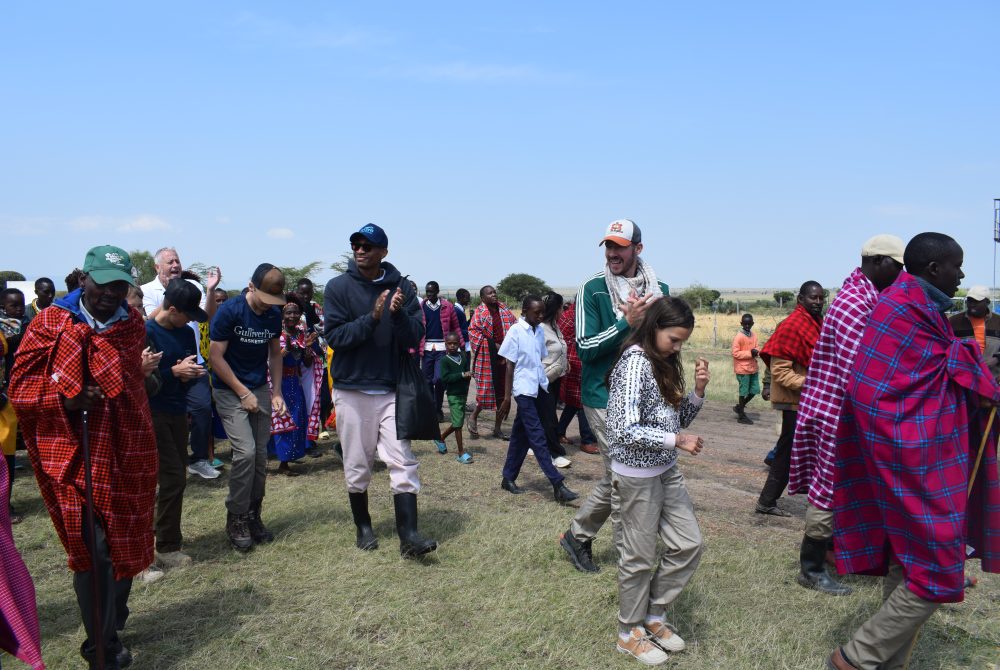
Dragić’s latest collaboration is with former Wall Street banker Andy Stein’s Orphaned Starfish Foundation and the Soloviev Foundation, a New-York based grantmaker founded on the late Sheldon Solow’s real estate fortune. Together, they recently built the first-ever basketball court at Ole Sere Primary School in Kenya’s Maasai Mara national reserve, traditionally home to the Maasai people. Situated in a region with a rich indigenous heritage, the court was developed alongside local leaders and educators and provides a safe, year-round space for play, mentorship and competition.
I recently connected with Dragić to find out more about why he brought his court-building work to Africa, how he connected with Orphaned Starfish and Soloviev, how he sees his athlete peers using their platforms, and where he sees his philanthropy heading next.
From Slovenia to the NBA: Goran Dragić’s giving
Born in Slovenia’s capital, Ljubljana, Dragić earned his hoops nickname “The Dragon” from the city’s emblem — a dragon that crowns the tower of Ljubljana Castle and adorns the iconic Dragon Bridge spanning the Ljubljanica River. Coming of age, he recalls taking a summer job with his mother at a book factory, where a majority of the employees were disabled. That experience lit a fire in him and inspired him to eventually use his platform to help those less fortunate.
Rising as an athlete, Dragić kept philanthropy in mind. Before his selection in the second round of the 2008 NBA Draft by the Phoenix Suns, he attended rigorous basketball camps where he met pro athletes already thinking about how to leverage their platforms for good. Watching them give back inspired Dragić to follow a similar path. “The most important thing for me was that when I finished my career, I finally had a platform, and it was time to give something back,” he said. “And I’m really happy that I can do that.”
Dragić focused on youth sports because participating in them fueled his own unlikely rise to becoming one of Slovenia’s greatest athletes. He began in his hometown in 2019, renovating the basketball court in Tivoli Park, Ljubljana. The project transformed it into Slovenia’s first “smart” basketball court, giving the court a facelift, while also integrating an online sports-educational platform, accessible through QR codes, that enriches every exercise with interactive training and games. Since that first smart court, the foundation has added seven more smart courts across Slovenia.
The foundation focuses on empowering disabled athletes, too, including providing specialized wheelchairs. When Dragić learned that each chair could cost upward of 5,000 euros, he was taken aback. “Those kids, they cannot afford that,” he said. So the foundation footed the bill for the Slovenian Wheelchair Basketball National Team. “This is something I was really proud of,” he added.
How Dragić came to collaborate with the Orphaned Starfish Foundation in Kenya
For Dragić’s latest effort in Kenya, his foundation is partnering with the Orphaned Starfish Foundation and the Soloviev Foundation. Founded in 2001 by former Wall Street banker Andy Stein, the Orphaned Starfish Foundation supports orphans, survivors of abuse, trafficking victims and at-risk children worldwide — establishing on-site computer labs, technology centers and educational programs in over 30 countries.
Each center is built and staffed in partnership with local communities, with Orphaned Starfish staying involved long term. The organization reports that more than 90% of its students achieve positive outcomes, while operating at about $120 per student, per year.
Dragić’s girlfriend Greice Murphy and fellow Orphaned Starfish board member Roberto Felipe connected him with Stein, who initially took him on a trip to Panama to tour orphanages that Orphaned Starfish was revamping. Dragić saw the dire conditions in which kids were living, but also how Stein was tapping a variety of tools to help them.
“[Stein is] one of the most unbelievable human beings that I got to know… I think it’s really important what he’s doing, especially bringing technology, education and job training to vulnerable kids. It changed my life,” Dragić said.
Later, during a planning meeting with Stein and Murphy, Dragić started thinking about his two young children and his desire to get them involved in service and gain perspective about challenges around the world. These reflections led him to Kenya this past summer, where he traveled with his family to meet leaders on the ground.
In addition to the new basketball court, Dragić highlighted other efforts there, like building a computer lab serving more than 1,000 youth, breaking ground on a soccer pitch, and even providing youth with education about self-sustaining farming practices.
Dragić emphasized that sport has enriched him in multiple ways and most of those lessons came in the form of intangibles like gratitude and resilience. “Just to see those kids, smiles on their faces, and play basketball with them, took me back to my childhood when I picked up the ball and was dreaming about someday becoming a basketball player.” Dragić said.
Dragić’s work with the Soloviev Foundation
Joining Dragić and the Orphaned Starfish Foundation in Kenya is the Soloviev Foundation, a somewhat under-the-radar funder that held nearly $330 million in assets in a recent year. The New York-based family foundation traces its roots to the late billionaire Sheldon Solow, a real estate developer and art collector who had a net worth of $4.4 billion in August 2020, according to Forbes, before he passed away later that year.
“Solow was a great collector of art works, some of which, by the way, are on display at our gallery and our headquarters at 9 West 57 [the Solow Building in Manhattan],” said Michael Hershman, CEO of the Soloviev Group, who also flew out to Kenya to see the project in person. Known as the Solow Art and Architecture Foundation for many years, the foundation changed its name once Sheldon Solow’s son Stefan Soloviev took the reins following his father’s death, and reverted to the original familial surname.
With that change came a revamped vision and foundation that now focuses on wounded veterans, hungry children, refugees and youth sports. Much of this work takes place in New York City, with grantees including Citymeals on Wheels and The Hope Foundation USA, which provides workplace training for the underemployed.
Both Hershman and Stefan Soloviev are also longtime athletes and self-described “sports fanatics,” and their collaboration with Dragić and the Orphaned Starfish Foundation was in line with the foundation’s longstanding interests. The partnership also builds on the foundation’s previous support of initiatives like Sports for Humanity, a Vatican-backed program promoting youth sports worldwide.
In a world where nonprofits sometimes struggle to find the perfect alchemy in their youth programming, Hershman offers this: “We just think that we can promote a sense of togetherness through teamwork, a sense of belonging, and teach honor and teach integrity through sports, a lot easier than it can be done in a classroom.”
Alongside youth sports, the foundation continues to engage in the arts, including an ongoing gallery exhibit highlighting African art, which runs alongside the family’s longstanding collection.
Related Inside Philanthropy Resources:
For Subscribers Only
Taking philanthropic inspiration from athlete peers and looking ahead
Throughout his career, Goran Dragić has shared the court with a who’s-who of NBA legends including Dwyane Wade, Jimmy Butler, Steve Nash, Chris Bosh, Amare Stoudemire, Shaquille O’Neal and Vince Carter.
The Dragon is quick to shout out Nash, whose court vision and ability to hold his own in the paint mirrored a style of play he also became known for. “Especially early on, when I came from Europe and played for the Phoenix Suns, my mentor Steve Nash was one of the most important figures in my career,” Dragić recalled.
Beyond the game itself, he absorbed lessons from teammates who had overcome humble beginnings, witnessing firsthand how athletes leveraged their platforms to give back. “All these players have such a huge following, and everybody is doing something to give back,” he said. “Most of them come from neighborhoods that shaped them, and now, kids are dreaming of one day being like them. That’s really important.”
For Dragić, philanthropy has always been personal. He started with outdoor courts back home in Slovenia, remembering the hours spent queuing for a chance to shoot hoops with friends. Like most millennials who are now starting to sound like their parents, he lamented how technology might dominate young peoples’ free time today, but that there’s still a need to encourage outdoor play and physical activity. And he seems poised to continue that work, whether it’s in Slovenia, Kenya or beyond.
“I wanted to give kids a space to get outside again, like when I was young,” he said. “When you’re on an outdoor court with friends, you learn teamwork, patience and how to push yourself. That’s something you carry for life.”
