





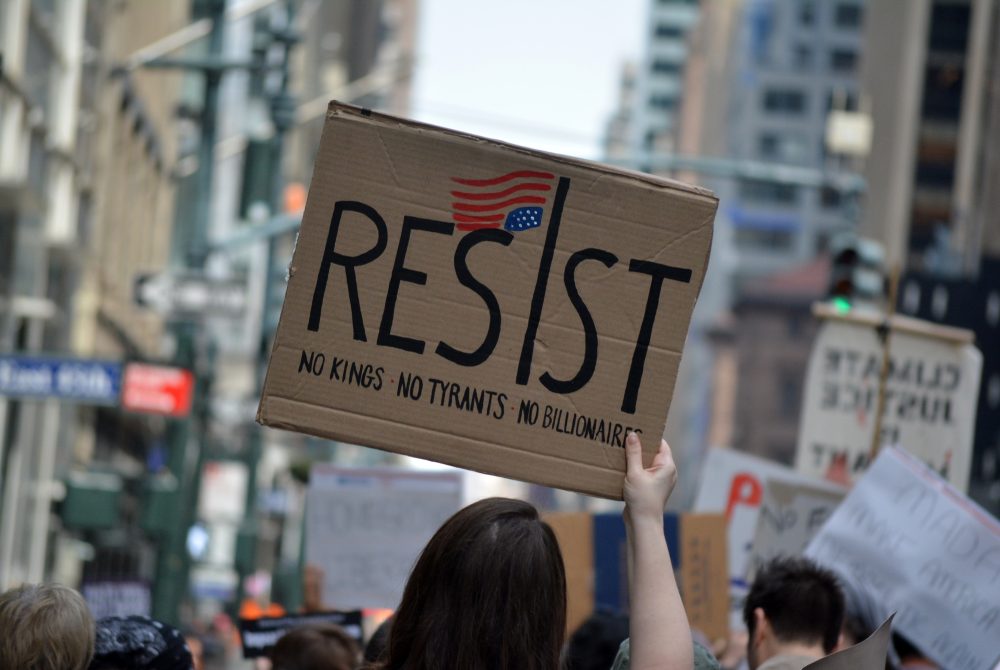
The past several months have seen unprecedented attacks against the constitutional right of free speech enshrined in the First Amendment. President Donald Trump and his administration have targeted pro-Palestinian protestors on college campuses, banned news outlets from the White House, sued several major news outlets, and mobilized troops against Americans who protest ICE raids and the administration.
Most recently, Trump has targeted the philanthropic sector, claiming the Open Society Foundations (OSF) funds political violence and terrorism. According to the New York Times, the Department of Justice is preparing to launch a criminal investigation into OSF. (OSF’s billionaire founder, George Soros, has long been a lightning rod for criticism from the right.)
OSF responded: “These accusations are politically motivated attacks on civil society, meant to silence speech the administration disagrees with and undermine the First Amendment right to free speech… Our work in the United States is dedicated to strengthening democracy and upholding constitutional freedoms. We stand by the work we do to improve lives in the United States and across the world.”
But the threats to philanthropy go beyond OSF and other grantmakers Trump and his allies have name-checked. Last week, Trump issued a presidential memorandum declaring his intent to establish a new law enforcement strategy to investigate any person or entity that participates in or supports what the administration deems are “criminal and terroristic conspiracies.”
Beyond directly violating the constitution, the Trump administration has also pressured media companies to silence late-night comedians for their criticism of the administration. Private companies are free to regulate speech on their platforms — although in the case of Jimmy Kimmel, FCC Chairman Brendan Carr’s threats to revoke ABC/Disney’s broadcasting license fall into murky territory related to government coercion — but the administration’s actions are nevertheless another example of efforts to censor anyone who disagrees with its policies.
“We are seeing the gravest assault on freedom of speech at least since the McCarthy era,” said Jonathan Hafetz, who is a professor of law at Seton Law School and membership officer of the IBA Human Rights Law Committee, in a recent blog post.
What funders can do to protect free speech
The good news is that many funders and other organizations throughout the civic sector remain committed to defending free speech, as evidenced by the swift response to ongoing attacks on the First Amendment.
Last month, a group of almost 150 funders published an open letter that criticized the administration’s efforts to exploit political violence to mischaracterize their philanthropic work and restrict fundamental freedoms.
“Our country is built on the premise that everyone has the right to express themselves, even when others don’t agree with or like what they say. No one should fear for their safety simply for expressing their views,” the letter said. As of Oct. 2, the number of signatories is up to 195. Numerous other foundation leaders and philanthropic institutions have echoed similar sentiments, reiterating their commitment to free speech and pledging solidarity with OSF.
In addition to expressing solidarity, funders can, perhaps most importantly, avoid preemptively censoring themselves or restrict their grantmaking out of fear of being targeted by the administration.
In a joint open letter addressed to leaders of American institutions this June, a group of organizations that aim to defend the First Amendment wrote, “It has been disheartening, however, to see so many others capitulating to the administration’s unconstitutional demands rather than asserting their rights. The logic that leads even powerful institutions to compromise or submit in these circumstances is, of course, easy to understand. But when one institution ‘bends the knee,’ its peers face increased pressure to do the same.”
While some foundations have removed parts of their websites — such as grant databases, staff biographies and information on what they fund — or removed language around DEI and race, it’s critical that funders continue their work, even if it is under the radar. Thankfully, many are doing so, even as other prominent grantmakers have made a point of pulling back from social justice funding.
Funders can also support organizations that are dedicated to defending free speech, such as those who published the open letter quoted above. These organizations include the ACLU, the Committee to Protect Journalists, Knight First Amendment Institute at Columbia University, Freedom of the Press Foundation, PEN America, Reporters Without Borders and the Foundation for Individual Rights and Expression.
Other groups include the First Amendment Foundation, Freedom to Read Foundation, First Amendment Coalition, the Free Expression Network and the Freedom Forum.
Philanthropists can also fund legal support for individuals or organizations whose First Amendment rights have been threatened or violated; provide support for organizations that engage in policy advocacy to reform restrictive policies; support an independent press and the safety of journalists; and fund educational efforts to inform the public about their rights, what free speech is, and how it is being undermined.
Funding education around free speech and the First Amendment is particularly important given the prevalence of mis- and disinformation online and efforts to undermine public education, where students would ostensibly receive education on civics and government.
Funders already doing the work to defend free speech
Supporting free speech is already top of mind for a selection of grantmakers, with some focusing on free speech overall and others focusing on particular aspects of the First Amendment, such as freedom of the press.
That includes journalism funders, who help bolster free speech through their support of a free and independent press. The John S. and James L. Knight Foundation, one of the most important journalism funders in the U.S., counts the First Amendment and journalist safety as one of its four key areas of investment through its journalism program.
“Safeguarding journalists,” Knight writes, “is pivotal for upholding a free press.” Knight supports efforts to protect journalists from legal and physical threats, backing organizations that provide litigation aid, assistance with Freedom of Information Act requests, and protection from physical threats.
Knight notes it is “dedicated to exploring innovative approaches that uphold these fundamental rights while actively ensuring a secure environment for journalists to pursue their vital work.”
In 2016, the Knight Foundation partnered with Columbia University to establish the Knight First Amendment Institute to help safeguard free expression in an ever-evolving digital landscape. The institute offers litigation, research and public education programs on new and longstanding threats to freedom of speech and the press.
Another major journalism funder, the MacArthur Foundation, also supports free speech and a free press through its journalism and media program, noting that it awards grants to national and international organizations that work to protect press freedom and address the safety and security challenges that journalists face.
Unsurprisingly, there is also significant overlap between democracy funders and funders who support free speech. “Democracy and free speech are inextricably linked,” advocates wrote in their open letter to institutional leaders. “If we are to govern ourselves, we must be able to inquire, speak, write, associate and protest without fear of government retaliation.”
A few examples of democracy funders that support free speech either directly or indirectly include the Democracy Fund, OSF, Ford Foundation and the William and Flora Hewlett Foundation.
Other funders who defend and support free speech include the Hugh M. Hefner Foundation, Stand Together and the Charles Koch Foundation, the John Templeton Foundation, the Rising Tide Foundation and the Rockefeller Brothers Fund.
Free speech has long been a rallying cry for the right, even prompting an executive order from Trump earlier this year, despite his administration’s numerous subsequent attempts to restrict it. It’s critical the public is aware of the distinction between those who purport to be “free speech absolutists” and those who actually work to defend the constitutional right.
One hopes that conservative philanthropies attuned to this issue — like Charles Koch’s Stand Together and Charles Koch Foundation — are alive to the level of threat now leveled at a foundational American right, and at grantmakers attempting to exercise it.
Related Inside Philanthropy Resources:
For Subscribers Only
Democracy at risk
Attacks on free speech are part of an ongoing pattern on the part of the administration to silence criticism. The right to protest, for example, is also protected by the First Amendment. It isn’t criminal activity. And yet Trump has all but declared war on Americans, particularly those who live in Democratic-led cities, in large part for exercising their right to protest. Attempts to silence criticism have also manifested in the form of restricting — even outright removing — access to information. These efforts include removing data from government websites, attacking Wikipedia, and cutting funding from libraries and public media.
Taking an even broader view, the administration is attempting to undermine other parts of the constitution — including the 14th Amendment, which protects birthright citizenship, and the 22nd Amendment, which limits presidential terms to two — as well as engaging in constant efforts to coalesce executive power.
It is understandable for funders to be concerned over the administration’s apparent appetite for direct attacks on philanthropy, but it is critical for them not only to refuse to retreat from free speech funding, but to deepen it and defend the freedoms that make democracy possible.
“If our democracy is to survive, the freedoms of speech and the press need a vigorous, determined defense,” the open letter reads. “Leaders of this country’s most powerful, well-resourced and prestigious institutions must play a larger part in this effort.”
